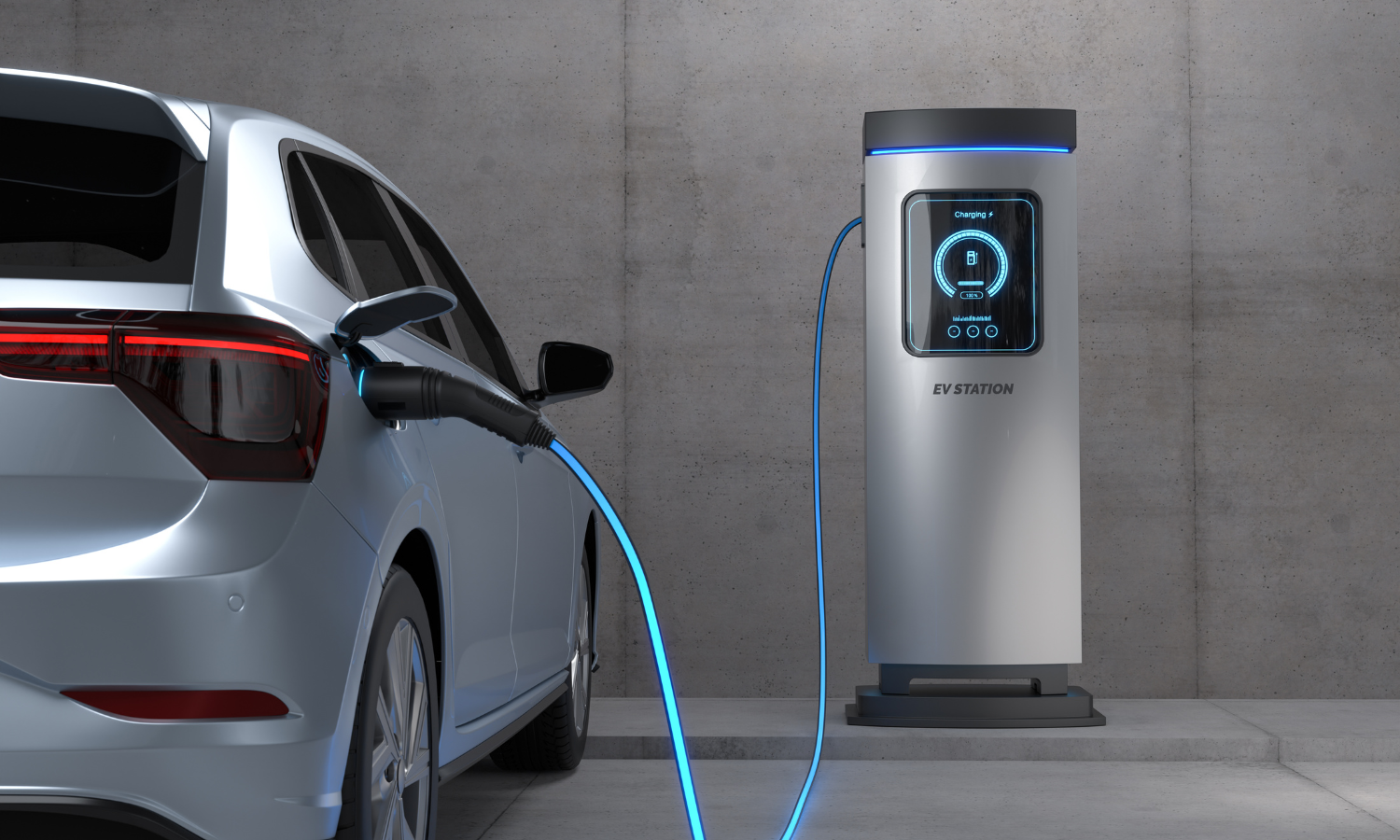
Quantum Advantage for Automotive & EV
The Battery Bottleneck: Solving Chemistry with Physics.
The transition to EVs is not a manufacturing challenge; it is a materials science challenge. We accelerate the ‘Lab to Fab’ timeline by simulating battery chemistry at the quantum level, solving the problems that define range, charge time, and cost.
The ‘Inverse Design’ Challenge
Trial-and-Error Chemistry
Discovering a new cathode material classically involves synthesizing thousands of candidates. It is slow, costly, and hits a ‘discovery bottleneck’.
Supply Chain Chaos
Just-in-Time (JIT) manufacturing collapsed during recent crises. Automakers lack the predictive tools to manage multi-tier supplier risks dynamically.
Quality Control in Gigafactories Standard NDT (Non-Destructive Testing) struggles to detect internal short-circuit risks in battery cells at production speed.

Industry Case Study (Ford Otosan): Commercializing Agility - Zero-Latency Production Replanning
The Complexity Wall (The Challenge): Modern automotive lines are victims of the Productivity Paradox. With highly configurable vehicle lines (1,000+ variants), sequencing is a chaotic, stochastic process. Classical algorithms took ~30 minutes to compute a schedule for just one batch. In a supply chain defined by shocks, this 30-minute lag meant the factory was always reacting, never anticipating.
The Quantum Breach (The Solution): Ford Otosan moved beyond the lab, integrating a Hybrid Quantum-Classical Solver directly into the production environment. This system bypassed standard heuristics to optimize the specific constraints of body-shop assembly and paint-shop sequencing.
Industrial Profit & Velocity (The Outcome):
Velocity: Scheduling time compressed from 30 minutes to <5 minutes.
Resilience: Enabled rapid re-balancing of workloads to absorb supply shocks.
Throughput: Recaptured lost manufacturing time, directly increasing peak throughput capability.

A 25-minute gain per run compounds into hundreds of hours of recovered production time annually. We treat time as capital; this solution stopped the bleeding.
LFI Core Operational Capabilities
The Battery Discovery Wall: Classical trial-and-error for new battery chemistries is too slow (5-10 years), delaying EV competitiveness.
-
The transition to the green economy is fundamentally a materials science race. Traditional trial-and-error discovery is prohibitively slow, often requiring 5-10 years to move new battery chemistries from "ab to fab. This creates a strategic lag, risking competitive obsolescence as rivals secure the intellectual property for higher energy densities and lighter alloys before you leave the experimental phase.
-
"AQ" Materials Simulation. We shatter the discovery bottleneck using Quantitative AI (AQ). We deploy hybrid pilots that utilize quantum simulation to generate high-fidelity synthetic data, training Large Quantitative Models (LQMs) to predict material properties with physics-based certainty. This compresses years of physical testing into months of digital discovery.

Production Latency: Stamping plants and assembly lines suffer from Job Shop scheduling inefficiencies that classical ERPs cannot solve.
-
Automotive stamping plants and mixed-model assembly lines operate as mathematical Job Shop environments where scheduling is an NP-Hard problem. Classical ERP systems are forced to rely on heuristics (static rules) to manage machine assignment, resulting in significant changeover latency and idle capital assets. In a Just-in-Time (JIT) ecosystem, this operational friction directly erodes margin per unit.
-
Hybrid Dynamic Scheduling. We replace static heuristics with hybrid quantum annealing solvers capable of optimizing complex production schedules in real-time. By navigating the vast combinatorial search space of your factory floor, we minimize changeover times and maximize asset utilization, delivering efficiency gains that classical solvers cannot find.
Battery Safety Risks: Traditional sensors miss early-stage magnetic anomalies in battery cells, risking thermal runaway.
-
The Thermal Runaway Blind Spot - Traditional Battery Management Systems (BMS) rely on lagging indicators (voltage fluctuations and temperature spikes) to assess health. They fail to detect the minute magnetic signatures of early-stage dendritic growth or cell degradation. This sensing blind spot leaves manufacturers vulnerable to catastrophic thermal runaway events and multi-billion dollar safety recalls that destroy brand trust.
-
Quantum Battery Health Monitoring. We deploy next-generation sensors based on Nitrogen-Vacancy (NV) centers in diamond to detect minute magnetic field anomalies associated with internal short circuits weeks before they manifest thermally. This provides non-invasive, high-precision monitoring that ensures Zero-Defect safety standards for high-performance EV packs.

The Talent Void: Auto manufacturers cannot hire enough PhD physicists to build internal quantum teams due to salary inflation.
-
The Talent Void (Strategic Paralysis) - The race for deep tech supremacy is stalling due to a structural talent shortage. With 50% of quantum jobs expected to remain unfilled and PhD salaries exceeding $300,000 annually, building a full-time internal team is financially inefficient. This leaves R&D directors without the physics expertise required to vet hardware vendors, risking expensive lock-in to the wrong technology.
-
The Virtual CQO (vCQO). We convert a prohibitive fixed cost into a flexible operational advantage. By engaging the Office of the CQO, you gain immediate access to elite physics talent and strategic vendor management. We act as your Radical Agnostic, ensuring your roadmap is driven by commercial validation rather than hardware hype.