Quantum Manufacturing for Advanced Industry
Beyond Industry 4.0: The Quantum Optimization Imperative.
Smart factories have hit a glass ceiling. The next leap in yield, energy efficiency, and throughput requires solving NP-Hard problems that break classical supercomputers. We integrate the hybrid solvers that turn mathematical chaos into competitive distance.

The Job Shop Deadlock: Your ERP system uses heuristics (best guesses) to schedule thousands of jobs across hundreds of machines. It leaves 10-20% of efficiency on the table.
Supply Chain Stochasticity: Linear models fail when global variables (weather, tariffs, shortages) interact unpredictably. You cannot optimize a network with 10⁵⁰ permutations using classical logic.
The Zero-Defect Illusion: Classical sensors miss the micro-fractures and thermal anomalies that cause downtime. You are reacting to failures, not predicting them.
The Bleeding Edge Problems
Industry Case Study (BASF): Shattering the Silicon Ceiling - From 10 Hours to 10 Seconds
The Complexity Wall (The Challenge): In a high-velocity liquid-filling facility, scheduling is not a calendar issue; it is a mathematical crisis. BASF faced an NP-Hard optimization problem: juggling tank availability, cleaning protocols, and delivery windows. Classical computing hit the Silicon Ceiling, requiring ~10 hours to generate a viable schedule. This latency resulted in dead capital, delayed jobs, idle machinery, and suboptimal tank utilization.
The Quantum Breach (The Solution): Rejecting the binary wait for fault tolerance, the team deployed a Hybrid Quantum Solver. By reformulating the scheduling logic to run on a quantum-classical architecture, they processed the facility's massive constraint lattice in real-time.
Industrial Profit & Velocity (The Outcome):
Time Compression: Scheduling reduced from 10 hours to seconds.
Operational Gain: Lateness reduced by ~14%.
Efficiency: Setup times cut by ~9%; tank unloading shortened by ~18%.

We do not wait for perfection. By deploying hybrid solvers today, we convert theoretical physics into ‘Efficiency-as-a-Service,’ unlocking immediate P&L gains.
LFI Core Operational Capabilities
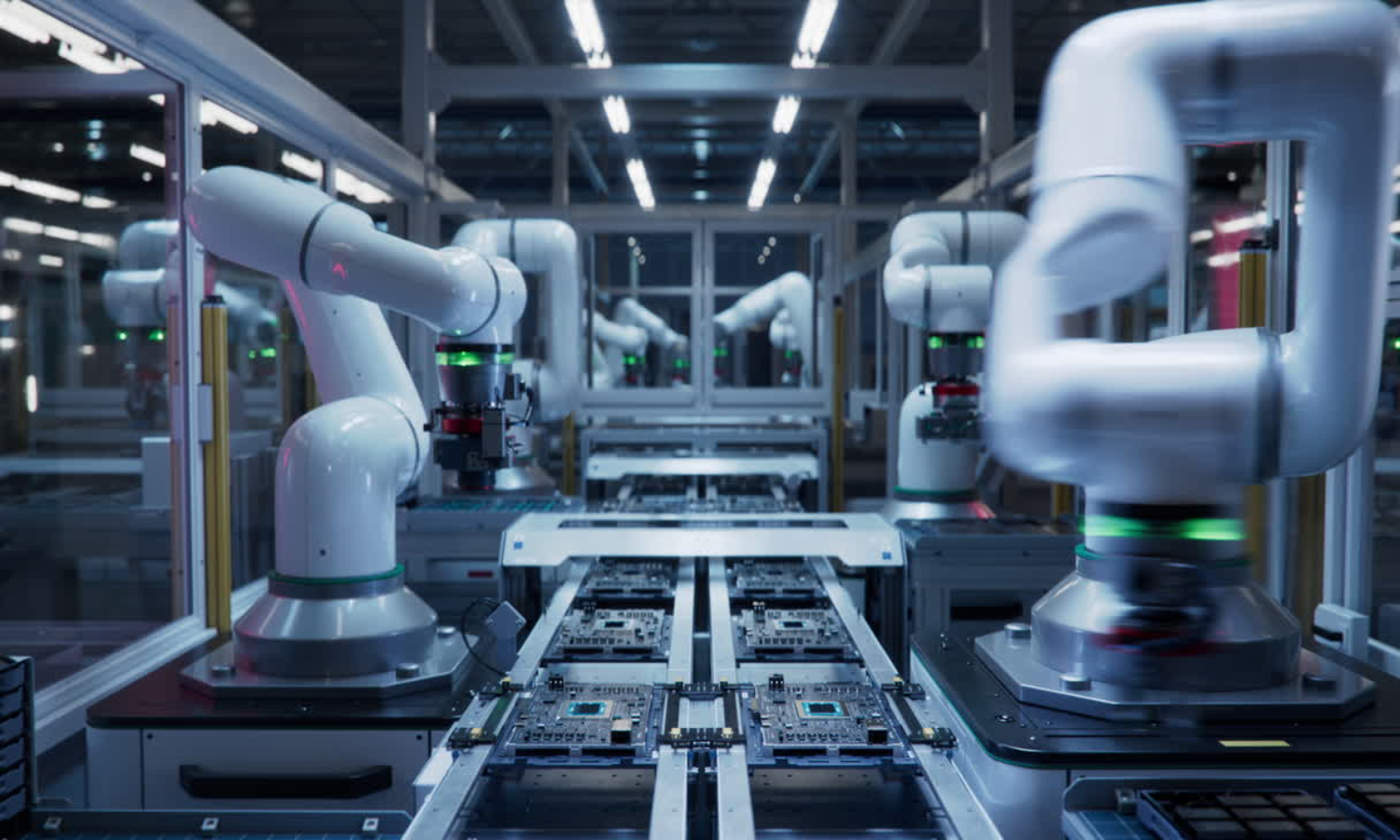
The Productivity Paradox: Investments in robotics and AI are plateauing because classical computing cannot bridge the complexity gap.
-
Despite massive capital expenditure on Industry 4.0, robotics, and AI, productivity growth is plateauing. This occurs because these technologies are developing in silos; classical computing lacks the computational power to bridge the Complexity Gap between them. The result is an inability to optimize production dynamically, leaving your expensive digital infrastructure underutilized and your ROI stagnant.
-
The Virtual CQO (vCQO). We act as the "Commercial Architect" of the Deep Tech era. We deploy the "AQ" (AI + Quantum) strategy, positioning quantum not as a standalone vertical, but as the computational keystone that unlocks the full potential of your existing AI and robotics investments. We provide the strategic leadership to integrate these silos and break the complexity wall.
Stochastic Simulation: Digital Twins fail to model real-world chaos (random variables) accurately due to computational latency.
-
Traditional digital twins fail to simulate complex, stochastic environments in real-time due to computational latency. As the number of random variables (machine breakdowns, supply shocks) increases, classical simulations lag behind reality. This renders your predictive models reactive, leaving the enterprise vulnerable to chaotic disruptions that could have been foreseen.
-
Quantum Digital Twins (QDT). We bridge the simulation gap by integrating quantum algorithms into your digital thread. This enables the generation of high-fidelity synthetic data to model complex physics and stochastic scenarios with unprecedented accuracy, identifying bottlenecks and failure modes before they occur physically.
The Scheduling Deadlock: Unsolved Job Shop Scheduling problems lead to expensive machinery sitting dormant.
-
Unsolved Job Shop Scheduling problems result in expensive capital assets sitting dormant. Because optimizing machine assignment is mathematically NP-Hard, classical ERP systems rely on heuristics (guesses) that fail to minimize changeover times. This operational latency directly erodes your Return on Invested Capital (ROIC).
-
Hybrid Optimization & Digital Twin Pilots. We reject the reliance on standard heuristics. We deploy hybrid quantum annealers to resolve scheduling constraints in real-time. By navigating complex energy landscapes to find global minima, we drastically reduce machine idle time and optimize bin packing, delivering immediate efficiency gains that standard solvers miss.
Board-Level Liability: Directors face fiduciary risk if they fail to prepare the enterprise for Q-Day and cybersecurity threats.
-
Directors face specific fiduciary risk if they fail to prepare the enterprise for Q-Day. The threat of "Harvest Now, Decrypt Later" (HNDL) attacks means that failing to secure long-lifecycle data today is not just a technical oversight, it is a breach of corporate governance that threatens cyber-insurance eligibility and long-term shareholder value.
-
Quantum Readiness & Risk Radar. We elevate cybersecurity to the Boardroom. We execute a Federal-Grade "Cryptographic Visibility & Inventory" (CVI) audit to assess your crypto-agility. We identify exposure to quantum decryption and map the migration to Post-Quantum Cryptography (PQC), ensuring defensible due diligence.