

QUANTUM UTILITY FOR ADVANCED INDUSTRIALS
Capture margin classical methods leave behind.
Some of this stage is executable now. Quantum sensing is commercially deployed, and hybrid quantum-classical optimization is producing measurable results in industrial operations today. Other parts arrive later as computing matures. LFI models what each is worth against your own operational baseline, then governs deployment independently, so the economics are proven before a dollar of vendor budget is committed.
What Is Already In Production.
50%
Production scheduling time reduction Ford Otosan (automotive body shop) in production daily.
10 hrs → 5 sec
Process scheduling solve time BASF (chemical bottling) 14% lateness reduction.
40% fewer cranes · 60% more deliveries
Logistics network optimization Port of Los Angeles - tens of millions in projected annual savings.
Each of these was a scheduling or routing problem where classical methods had hit an economic ceiling. The question for your operation is not whether this works. It is whether you have a problem with the same signature, and what solving it is worth to you.
“The biggest risk in quantum isn’t being late - it’s being early without leadership.”
Your Planning System Is Working. Your Business Has Outgrown It.
The scheduling and optimization problems that matter most to your operations have a common signature: they take too long to solve, they force your planners to simplify and abstract, and they cannot reoptimize fast enough when the business changes.
Classical solvers were not built for the complexity levels advanced manufacturers face today. Multi-plant scheduling with non-linear setup relationships. Fleet routing across thousands of variables. Workforce allocation across hundreds of simultaneous constraints. Process sequencing with multi-objective trade-offs that MILP solvers are forced to linearize and approximate.
The result shows up in your P&L. In batch schedules run overnight that are obsolete by morning. In routes that leave capacity on the table. In recovery times measured in hours when they should be measured in seconds.
This is not a technology gap. It is a Productivity, Profitability, Throughput, Yield, and Resilience gap, and it has a quantifiable dollar value.
Four Signals That Quantum Utility Is Worth Evaluating
Solve Time
Your scheduler runs overnight or takes hours. Replanning after a disruption is a manual process. Compressing that to seconds would change how your operations team makes decisions.
Solution Quality
You plan at family level because SKU-level takes too long. You approximate non-linear relationships because your solver requires linearity. You are leaving fidelity (and margin) on the table.
Model Maintenance
The team hours required to maintain, recalibrate, and extend your current optimization model are significant. It was built for a business that has since evolved. That overhead is a cost most organizations never quantify.
Agility
When a disruption hits (a supplier fails, a machine goes down, a demand spike arrives) real-time replanning is the capability that converts speed into resilience. If your current system cannot do it, that gap has a margin value.


The Technology in Production Now
Quantum utility today is predominantly annealing-based and analog optimization that is purpose-built for the combinatorial complexity that defines industrial operations. Multiple hardware and software platforms are in production today across LFI's target industries.
-
Maps optimization problems onto quantum chip energy states. Physically finds the global optimum — escaping the local optima traps that classical solvers cannot. Production-grade at 99%+ uptime. Key partner: D-Wave
-
Classical semiconductor hardware mimicking quantum annealing behavior. Room temperature, scalable to thousands of variables, commercially mature. No new infrastructure required. Key partner: Fujitsu
-
GPU and FPGA algorithmic approach. Runs on existing infrastructure. Purpose-built for high-frequency re-optimization where speed is the primary constraint. Key partner: Toshiba
-
Rydberg atom arrays in analog mode. Graph-structured optimization and emerging industrial use cases. Deployed in HPC environments via cloud access. Key partners: Pasqal, QuEra
*LFI holds no commercial relationship with any quantum vendor. Technology selection is governed independently through the QUG Partner Selection Framework, based on your problem structure, not our partnerships.
The Industrial Problems Quantum Utility Solves Today
-
![Assembly line of electric vehicles in a modern factory, with one partially assembled blue car in the foreground and several other cars in various stages of assembly in the background.]()
Production Scheduling
Job shop scheduling, body shop sequencing, multi-product line scheduling with non-linear setup times. Solve times from hours to minutes or seconds. Real-time rescheduling when priorities change.
Automotive · Advanced Manufacturing · Energy & Chemicals
-
![Cargo ships and trucks at a port with a small airplane flying overhead during sunset.]()
Logistics & Vehicle Routing
Capacitated Vehicle Routing Problem (CVRP), fleet dispatch, multi-depot network optimization. Real-time replanning across dynamic, multi-echelon supply networks. Combinatorial complexity that classical heuristics cannot solve without pruning.
Logistics · Mining · Aerospace & Defense
-
![Inside a modern warehouse with automated conveyor belts transporting packages, with yellow safety rails and industrial equipment.]()
Process & Chemical Sequencing
Multi-objective process scheduling with non-linear constraints. Simultaneously minimizes setup time, satisfies demand, and optimizes resource utilization, without the linearization approximations MILP requires.
Energy & Chemicals · Advanced Manufacturing
-
![People walking on a busy indoor floor, seen from above.]()
Workforce & Resource Allocation
Shift scheduling, skills-constraint matching, real-time task assignment across hundreds of simultaneous constraints. Validated in logistics copilot problems: 100 workers and 50 concurrent tasks at sub-second response targets.
Aerospace & Defense · Advanced Manufacturing · Logistics
-
![A person in a yellow safety vest and white hard hat walking through a warehouse aisle with shelves filled with boxes and supplies.]()
Inventory Optimization
Multi-echelon inventory placement, replenishment planning across suppliers and distribution centers. Balancing cost minimization with service level across thousands of SKUs simultaneously.
Logistics · Automotive · Advanced Manufacturing
-
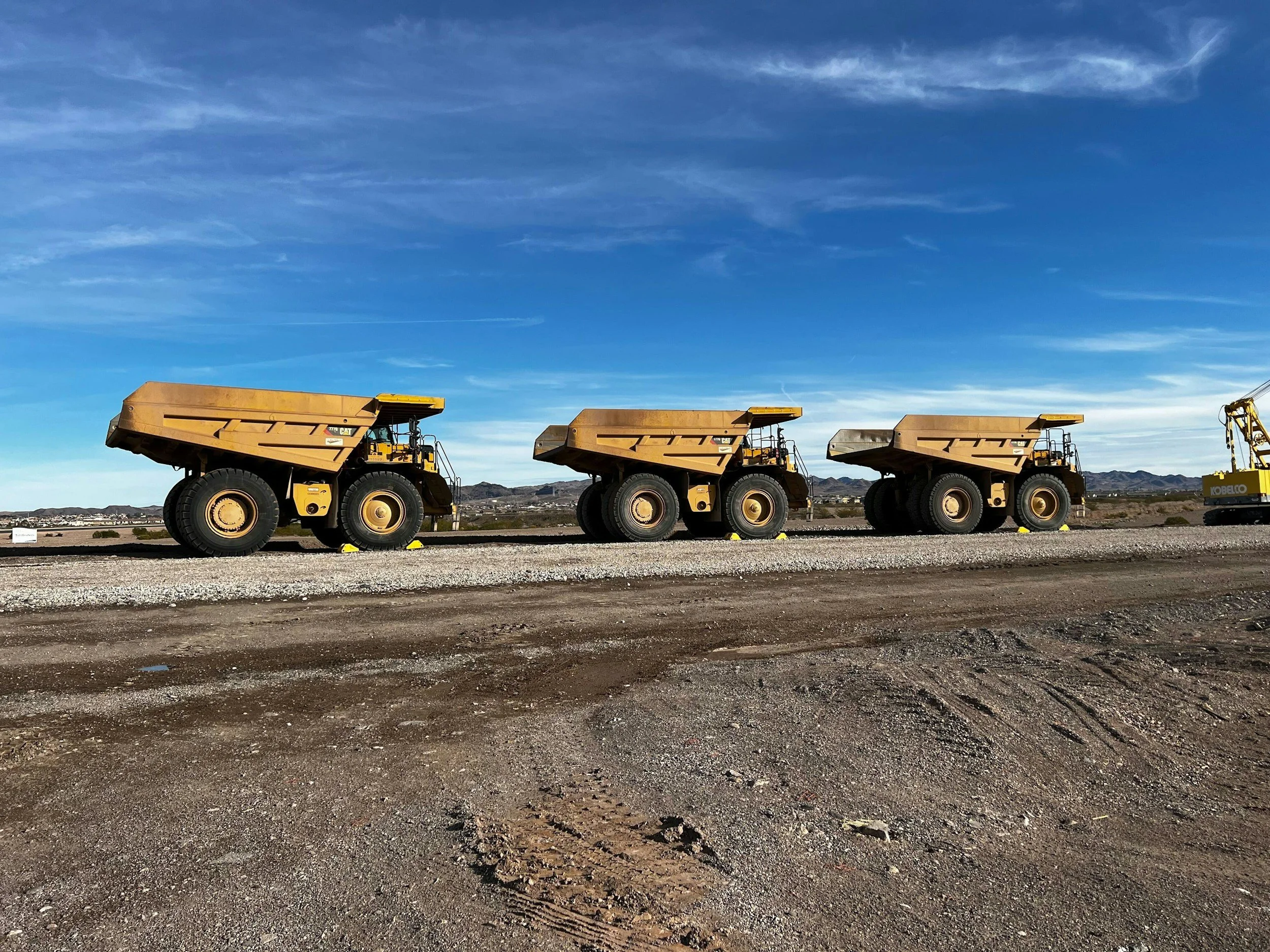
![Three large yellow dump trucks parked in a row on a construction site with a gravel surface, with mountains and a blue sky with wispy clouds in the background.]()
Ore Body & Haul Route Optimization
Mine scheduling, fleet and asset allocation across multiple sites, haul route optimization for energy cost reduction. Complexity scales exponentially with fleet size, which is exactly where quantum outperforms classical.
Mining & Resources
-
![A logistics warehouse with stacked shipping containers, overlaid with a digital globe and icons representing connectivity, transportation, and communication.]()
Supplier & Procurement Optimization
Multi-supplier selection, replenishment planning, portfolio optimization across quality, cost, and geography constraints. Maximizing supply chain resilience without sacrificing margin.
All six LFI sectors
-
![Close-up of an electric power transmission tower with glowing power lines against a blue sky.]()
Network & Grid Optimization
Energy grid scheduling, process plant optimization, grid-scale battery placement. Quantum-inspired algorithms matched or outperformed classical benchmarks on capital allocation and network stability.
Energy & Chemicals







How We Protect Your Optimization Investment.
Quantum optimization is real and delivering results today. But it’s also a market where premature commitments can cost more than waiting. LFI protects you from the three risks that turn quantum promise into commercial liability:
| Risk | What It Looks Like | How LFI Protects You |
|---|---|---|
| Premature Investment | Running a quantum pilot on a problem where classical solvers already perform well enough - burning budget on science projects that never reach the P&L. | We benchmark your bottleneck first. If classical is sufficient, we tell you. Every pilot is scoped to a problem where quantum-classical hybrid actually outperforms. |
| Vendor Lock-In | Committing to a single quantum platform before the market has matured, constraining your options as better solutions emerge. | We are technology-agnostic. We select the right solver for your problem from across the hybrid quantum ecosystem - and we change it when something better arrives. |
| Leadership Gaps | Delegating quantum optimization to IT, a vendor, or an innovation lab without executive governance - where expensive mistakes compound undetected. | The vCQO governs every optimization engagement: scoping, vendor selection, integration, measurement, and the go/no-go decision on scaling. |

Technology-Agnostic. Outcome-Committed.
LFI maintains active partnerships across the hybrid quantum-classical optimization ecosystem - quantum annealing providers, gate-based quantum computing platforms, quantum-inspired classical solvers, and specialized optimization software companies.
We do not represent any single vendor. Our technology syndicate gives us access to the right tool for your specific problem, and the independence to change tools as the market evolves. This is a fundamental part of the vCQO function: the vendor decision is a leadership decision, and it should be governed - not outsourced to the vendor themselves.

How LFI Governs a Quantum Utility Deployment
Four sequential Quantum Utility Governance (QUG) products. A decision gate between each. No vendor executes anything without passing independent economic assessment.
QUG Discover
2–4 days
Vendor-free workshop. Output: Quantum Utility Opportunity Map with ranked problems, Quantum Fit Scores, and economic value at stake.
QUG Evaluate
6 weeks
Independent three-scenario ROI model. Output: Quantum Utility Investment Brief. Typical engagement identifies $1M–$5M per $100M revenue.
QUG Procure
8 weeks
LFI issues the RFP. Evaluates vendors against your economic scorecard. No vendor advances without passing an independent assessment.
QUG Govern
Annual retainer
Quarterly performance reviews against the original ROI model. LFI holds vendors accountable across the full program lifecycle.
Total: 4 – 9 months to production. QUG Govern continues for the program lifecycle.
Related Insights and Publications




Start with a Vendor-Free Assessment
QUG Discovery is a 2–4 day LFI-led workshop with no vendor in the room. It tells you whether your operations have a quantum utility opportunity worth pursuing, which problem to lead with, and what the economic value at stake looks like. If the economics do not justify moving forward, LFI will tell you that.