
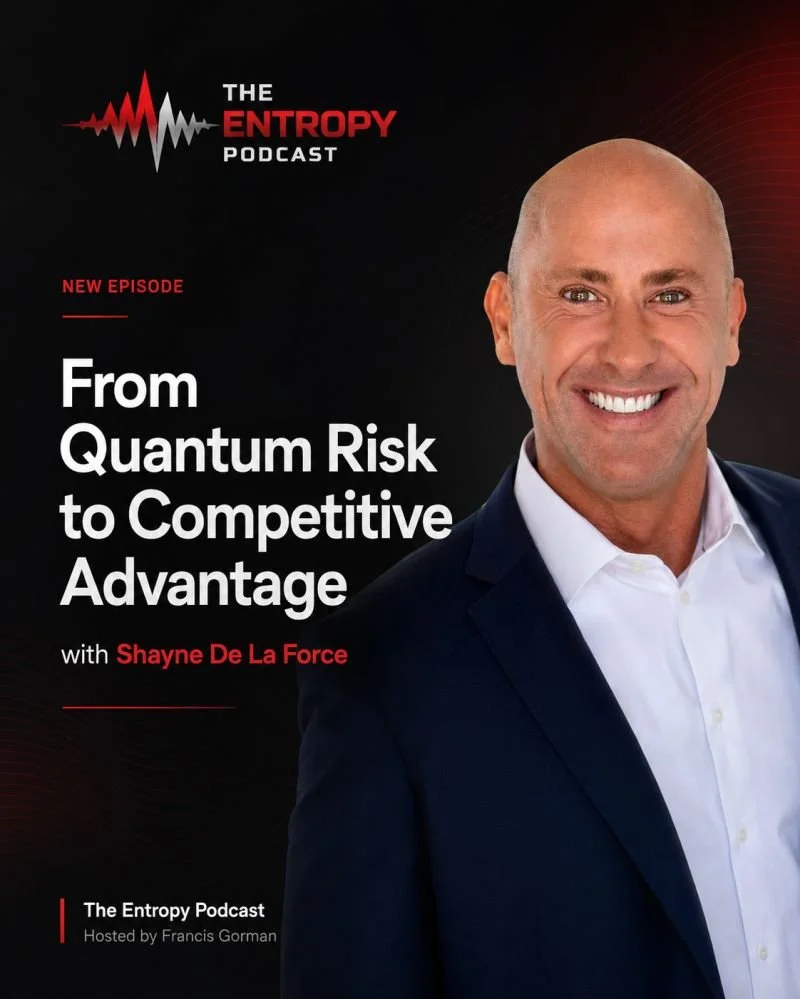
The Entropy Podcast: From Quantum Risk to Competitive Advantage with Shayne De la Force
Quantum technology promises enormous economic value, but are businesses preparing quickly enough to capture it or protect themselves from its risks?
In this episode, Francis Gorman speaks with strategy leader and LFI founder Shayne De la Force about the commercial realities of quantum technology in advanced manufacturing. Drawing on decades of experience across the semiconductor, aerospace, defence and automotive sectors, Shayne explains why quantum must become a board-level economic and governance priority.
They explore the cost of waiting, the challenge of securing global supply chains, the role of an embedded Chief Quantum Officer, and why businesses need to look beyond vague terms such as “quantum advantage” and “quantum readiness.”
Shayne also reflects on beginning his career on a factory floor in Japan, the dangers of “synthetic seniority,” and the lessons behind his book, Strategic Entanglement, which helps deep-tech founders cross the valley of death between innovation and commercial success.
The electrification analogy every automotive executive should understand.
In the year to February 2026, the world's major automakers wrote down roughly sixty billion dollars of electrification capital. Stellantis 26.5 billion. Ford 19.5 billion. General Motors six billion. The consensus reading is that the technology was oversold.
That reading is wrong, and the firms holding it are about to pay for it a second time.
Robert Solow established in 1957 that capital accumulation explained about an eighth of the growth in output per hour worked. The rest was the residual, and the residual is not something you can buy. Paul David then showed exactly where it lives, using the one industrial transition that maps onto quantum almost perfectly: factory electrification.
Schumpeter's cold douche: What quantum destroys before it creates.
On July 13, 2026, the Department of War suspended CMMC Phase 2. More than 100,000 defense industrial base firms needed a third-party assessment. Roughly 100 assessors existed. The date moved because the arithmetic did not work.
That suspension is the most useful thing to happen to defense sector capital allocation this year, and almost nobody is reading it correctly. It is not a reprieve. It is a live demonstration of an economic result from 1963: the cost of adjusting a capital stock rises faster than the speed of the adjustment. Compress the timeline, and the same work costs multiples.
Post-quantum cryptography has the same structure, a worse ratio, and a deadline no task force can suspend.

Quantum Is Coming. Here Is What to Build Today.
Quantum computing is expected to reach the threshold the industry calls Quantum Advantage sometime around 2029 or 2030, based on current technology roadmaps. That date does not move because a manufacturer chooses to wait. What moves is everything downstream of the decision: how much runway is left to build, and how much of it gets spent making up for lost time.
Most manufacturers treat this as readiness for a single future event. It is not. It is four separate builds, each one buildable now, each one paying its own way before the others are finished. A foundation poured without a survey fails. A pilot run without governance behind it gets stranded. A span opened before the foundation is set does not hold. The manufacturers ahead are not the ones with the most advanced technology. They are the ones who got the sequence right.
This week's insight lays out the four-stage roadmap, the twelve specific actions inside it, and the four questions that tell you exactly which stage your organization is standing at today.

Planning Against a Moving Standard: LFI Joins the Post-Quantum Cryptography Coalition
In 2016, the National Institute of Standards and Technology opened a public competition to find the algorithms that would replace RSA and elliptic curve cryptography before a large enough quantum computer arrives. Eight years, several broken finalists, and three rounds of public cryptanalysis later, NIST published the first three standards on August 13, 2024. The competition to choose the algorithms is over.
The competition to migrate every system that depends on them is not. It is being run in the open, across coalitions, working groups, and roadmaps that most executive teams never see, and the guidance inside it is still moving. A migration plan built against today's snapshot risks rework tomorrow, and rework is budget spent twice for exposure bought down once.
LFI has joined the Post-Quantum Cryptography Coalition (PQCC) to sit inside that process on behalf of advanced manufacturers, and to keep LFI clients planning against the guidance as it develops, not a snapshot from when their engagement began.

The hardware you buy today is not the competitive moat you think it is.
Somewhere in a semiconductor company right now, a very smart person is building a slide. It proposes a large capital allocation toward quantum hardware, and the logic is so clean that nobody in the room will challenge it. Quantum confers advantage. Owning quantum confers advantage. Buy it before the competition does.
Every step in that chain is reasonable. The conclusion is wrong, and the reason has nothing to do with physics. In 1991, management professor Jay Barney established that a resource produces sustained competitive advantage only when it is Valuable, Rare, Inimitable, and Non-substitutable. Quantum hardware clears two of those four hurdles. Your competitor can rent equivalent capability tomorrow from Amazon Braket, Microsoft Azure Quantum, or IBM Quantum Platform, with a corporate credit card and no board meeting.
That is not a moat. That is a head start with an expiration date, purchased at capital expenditure prices. The resources that actually pass Barney's test are already sitting inside your firm. Unmeasured. Ungoverned. Unbuilt.

The Global Manufacturing Sugar High Is Wearing Off
Global manufacturing spent five months looking strong, then June's numbers arrived: growth slowing, hiring falling, optimism at an eight-month low. A blunt read on the first half of 2026, and why the same buy-now, govern-later reflex is a risk for manufacturers eyeing quantum investment next.
Quantum Economic Advantage does not require quantum supremacy.
In 1838, Augustin Cournot published a mathematical model of two firms competing on quantity in the same market. It became the foundation of modern competition economics, and it produces a result most manufacturers evaluating quantum have never applied to their own decision: a firm does not need superior technology to win. It needs a lower cost structure.
In 2022, economists Francesco Bova, Avi Goldfarb, and Roger Melko proved why. Their Cournot duopoly model shows a quantum computing firm can be more profitable than a classical competitor even when both complete identical calculations, meaning no computational advantage exists anywhere in the model. The advantage comes entirely from cost asymmetry. Quantum computers, the authors conclude, may not need to display a quantum advantage to generate a quantum economic advantage.
This week's article applies that result to the manufacturer's decision. Semiconductor manufacturers waiting for a physics-declared demonstration of supremacy are optimizing for the wrong variable. Competitors only need to remain more expensive or slower, and the advantage accrues to whoever moves first.
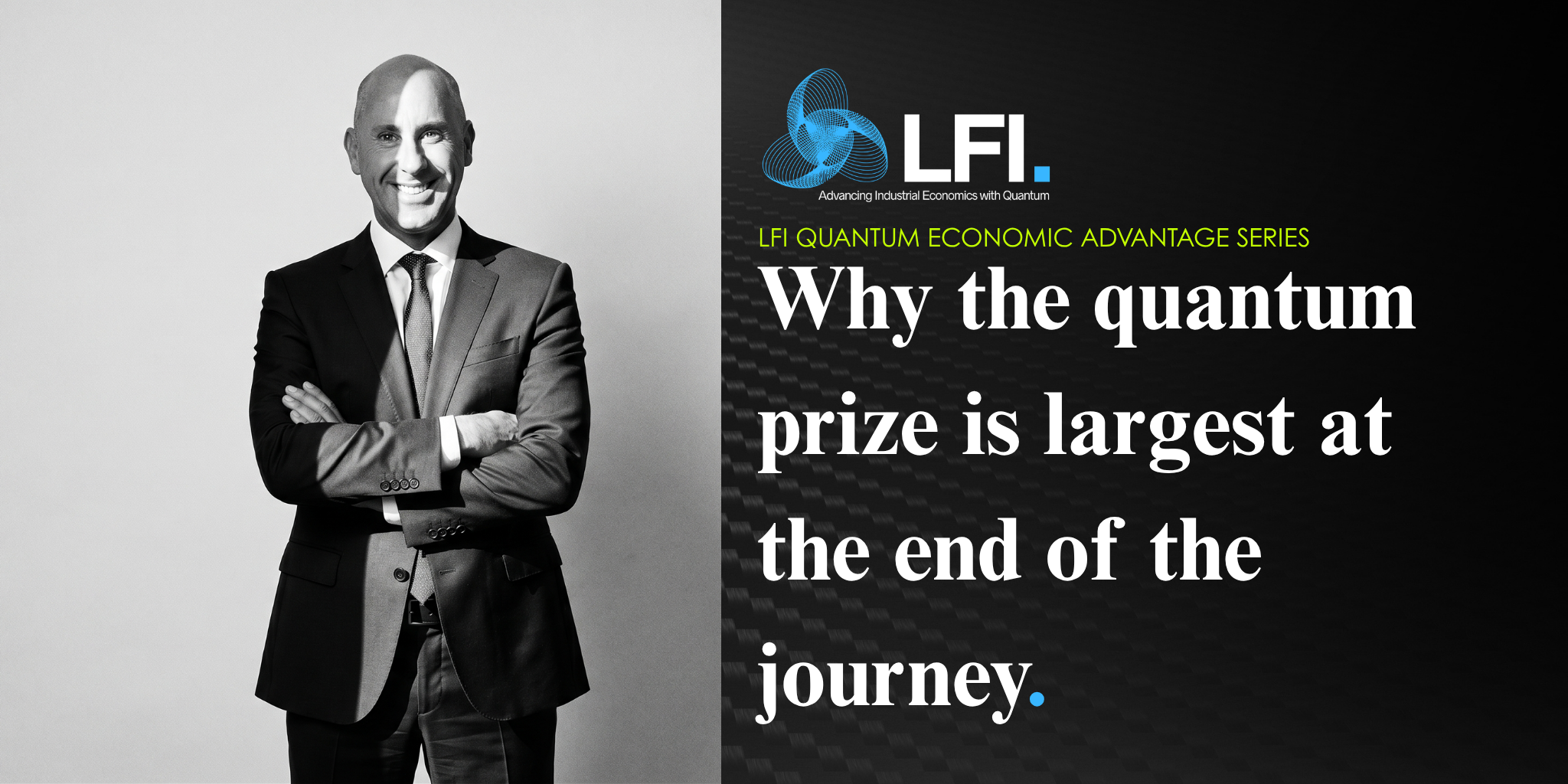
Why the quantum prize is largest at the end of the journey.
In 1987, Robert Solow observed that the computer age was visible everywhere except in the productivity statistics. A decade of technology investment had produced no measurable gain, because the benefit was not in the hardware. It was in the reorganization of operations around it. Automotive and electric vehicle manufacturers are about to face the same lesson with Quantum Technologies.
Solow's growth accounting framework explains why the quantum prize is largest at the end of the journey, not the beginning. Each stage of the Quantum Value Stages™ is a prerequisite for the next, and the economic weight is not uniform across them. Quantum Advantage delivers roughly as much value as Quantum Readiness, Security, and Utility combined. Manufacturers who stop at Security pay the entry fee and forfeit the prize.
The manufacturers who govern the full journey are not making a technology bet. They are making a capital allocation decision with a modeled return, a defensible timeline, and a governance sequence they can explain to a board. The prize is real. It is not where most capital allocators are currently looking.

LFI Appoints Defense and Manufacturing Operator Michael Datta to Board of Advisors
LFI, the world's first industrial quantum management firm, has appointed Michael Datta to its Board of Advisors. Mr. Datta is Co-Founder and Chief Security Officer of Ares Armaments, an Australian defense technology company specializing in counter-unmanned aerial systems, and a Strategic Advisor at Noosa Partners, bridging the US-Australia cross-border advisory corridor. He brings more than two decades of operating experience building and scaling companies across defense and advanced manufacturing.
The appointment expands a board that already includes former Australian Ambassador to the United States Arthur Sinodinos AO, and reflects LFI's growing commercial momentum across North America and the Asia Pacific. As a vendor-independent firm with no product to sell and no vendor equity, LFI governs the full quantum journey for advanced manufacturers across the semiconductor, aerospace, defense, and automotive and electric vehicle sectors.